
Table of Contents
URLs are one of the most important parts of the internet. Every webpage, image, file, API endpoint, and online resource is accessed through a URL. However, URLs cannot safely contain every possible character. This is where URL encoding becomes essential.
If you’ve ever wondered what is URL encoding and why is it used, you’re looking at a technology that quietly powers websites, web applications, APIs, online forms, and search engines every day.
URL encoding ensures that special characters, spaces, symbols, and non-standard text can be safely transmitted through a URL without causing errors or breaking functionality.
In this guide, you’ll learn what is URL encoding and why is it used, how URL encoding works, real-world examples, common mistakes, decoding methods, and how developers and website owners use URL encoding in modern web applications.
What Is URL Encoding?
URL encoding is the process of converting special characters into a format that can be safely transmitted over the internet as part of a URL.
URLs can only contain a limited set of characters. Characters such as spaces, ampersands, percentage signs, question marks, and non-English text must be encoded before being included in a URL.
For example:
Hello World
becomes:
Hello%20World
In this example, the space character is encoded as %20.
Understanding what is URL encoding and why is it used helps explain how websites reliably transmit information across browsers and servers.
Why URL Encoding Is Important
Web browsers and servers follow strict rules when processing URLs.
Without URL encoding:
- URLs may break
- Data may become corrupted
- API requests may fail
- Forms may not submit correctly
- Special characters may be misinterpreted
URL encoding ensures information is transferred safely and consistently between systems.
This reliability is one of the main reasons developers frequently work with URL encoding.
How URL Encoding Works
To understand what is URL encoding and why is it used, it’s helpful to understand how characters are converted.
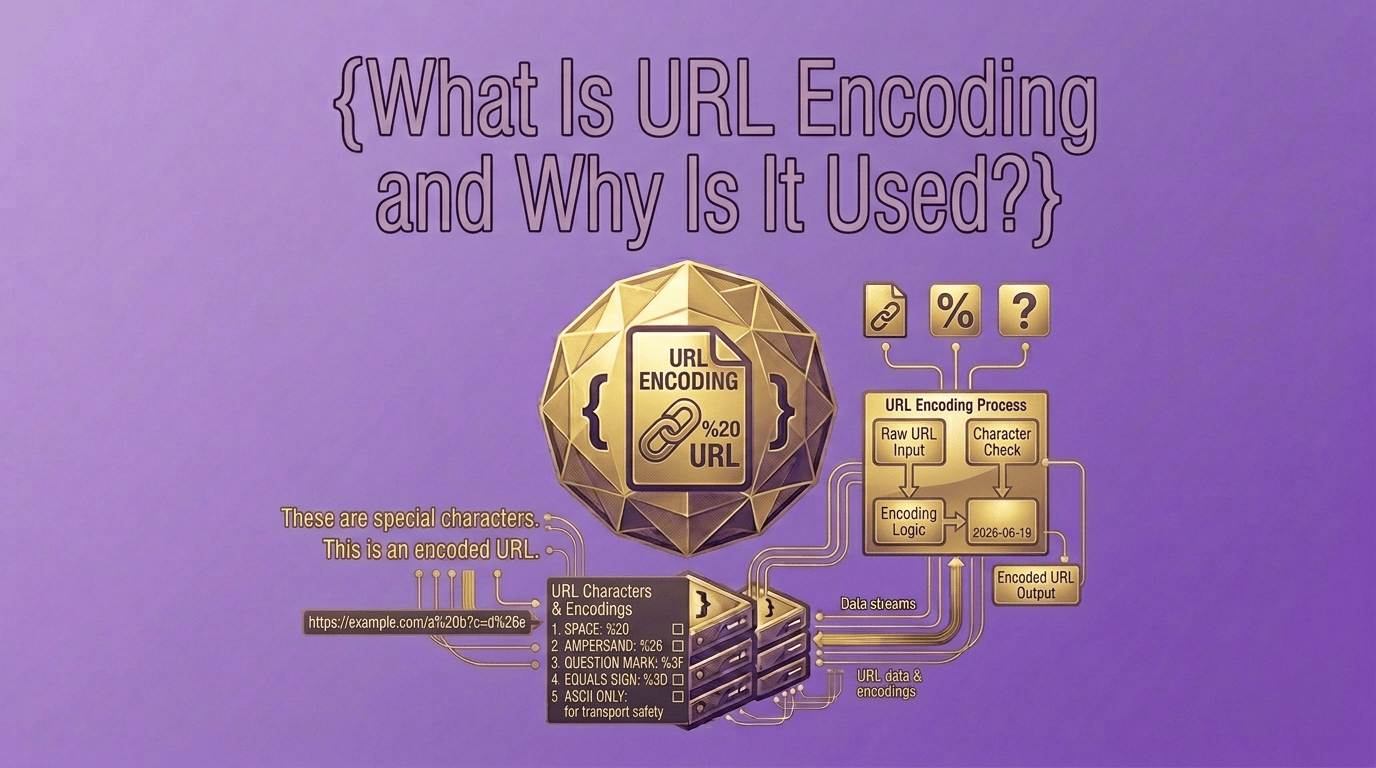
When a special character appears in a URL, it is replaced with a percent sign (%) followed by its hexadecimal ASCII value.
Examples:
| Character | Encoded Value |
|---|---|
| Space | %20 |
| ! | %21 |
| # | %23 |
| & | %26 |
| ? | %3F |
| @ | %40 |
The browser automatically decodes these values when processing requests.
Simple URL Encoding Example
Imagine a search query:
https://example.com/search?q=red shoes
The space inside the search term must be encoded.
Encoded version:
https://example.com/search?q=red%20shoes
This ensures the browser and server correctly understand the request.
Real-World Example of URL Encoding
Consider an online travel website.
A user searches for:
Flights from New York
The search query contains spaces.
Before the request is sent to the server, the URL becomes:
Flights%20from%20New%20York
The server receives the encoded value and processes the search correctly.
This is one of the most common examples used to explain what is URL encoding and why is it used in practical situations.
What Is URL Decoding?
URL decoding is the reverse process of URL encoding.
It converts encoded characters back into their original readable form.
Example:
Hello%20World
becomes:
Hello World
Developers frequently encode data before transmission and decode it when displaying information to users.
When URL Encoding Is Used
URL encoding appears in many web technologies.
Search Queries
Search engines encode spaces and special characters.
Online Forms
Form data often requires encoding before submission.
APIs
API requests frequently include encoded parameters.
Dynamic URLs
Applications generate URLs containing user-generated content.
Multilingual Websites
Non-English characters often require encoding.
URL Encoding in SEO
Website owners occasionally encounter URL encoding while managing websites and SEO campaigns.
For example:
- Tracking parameters
- UTM campaign URLs
- Search URLs
- Redirects
- Canonical URLs
Proper encoding helps ensure URLs remain valid and accessible.
Common URL Encoding Mistakes
Encoding an Entire URL Incorrectly
Sometimes developers accidentally encode portions that should remain unchanged.
Double Encoding
Encoding already encoded data can create broken URLs.
Example:
%20
becomes:
%2520
This often causes application errors.
Forgetting to Decode Data
Users may see encoded text instead of readable information.
Ignoring International Characters
Multilingual websites often require proper encoding support.
URL Encoding vs URL Decoding
| Process | Purpose |
|---|---|
| Encoding | Converts special characters into URL-safe format |
| Decoding | Restores encoded characters to original format |
Both processes are essential for reliable communication between browsers and servers.
How to Encode URLs Online
Instead of manually converting characters, developers often use dedicated tools.
Our URL Encoder tool can quickly convert text into URL-safe format.
Likewise, our URL Decoder tool can restore encoded content back into readable text.
If you’re looking for a practical walkthrough, read:
What Is URL Encoding and How to Decode It
Who Should Learn URL Encoding?
URL encoding is useful for:
- Web developers
- API developers
- Website owners
- SEO professionals
- Technical marketers
- Students learning web technologies
Even users with limited technical experience may encounter URL encoding while working with tracking links and website parameters.
Frequently Asked Questions
What is URL encoding and why is it used?
URL encoding converts special characters into URL-safe values so they can be transmitted correctly through web browsers and servers.
Why are spaces encoded as %20?
The space character is represented by hexadecimal value 20 in URL encoding.
What is URL decoding?
URL decoding converts encoded values back into their original readable characters.
Do all URLs require encoding?
No. Only URLs containing special characters or unsupported symbols require encoding.
Can URL encoding affect SEO?
Proper URL encoding helps ensure URLs remain accessible and function correctly, which supports overall website quality.
Conclusion
Understanding what is URL encoding and why is it used is valuable for developers, website owners, SEO professionals, and anyone working with modern web technologies. URL encoding provides a reliable way to safely transmit special characters and structured information through URLs.
Without URL encoding, many websites, APIs, search engines, and online applications would struggle to process information correctly. By understanding both encoding and decoding, you can avoid common errors and work more effectively with web-based systems.
To continue learning, explore our URL encoding tools and related tutorials for practical examples and hands-on experience.
Related Tools
Related Articles
About the Author
Fadi is the founder of Prime Toolbox, where he publishes educational content about web development, SEO, business tools, and online utilities. His goal is to make technical concepts easier to understand through practical guides and beginner-friendly resources.
Last Updated: June 2026